THE SURCH FOODS BLOG

Expert insights, sourcing guides and ideas that connect better food with better business.

Ideas and know-how for every part of the food supply chain.

Showing 9 of 92 articles

alt="Balancing cases on wooden seesaw with blue background."

Distributors

Distributor or direct: how to decide

The cost of working with a distributor is easy to state and hard to actually evaluate. Most suppliers can quote the margin percentage without hesitation. Far fewer have worked out what that margin is actually buying, or what it's costing them beyond the number itself. The margin is just the part that shows up on an invoice. The rest of the cost shows up later, in decisions the supplier no longer gets to make alone.

Oct 16, 2026 · 4 min read

alt="Ship at port with shipping containers and cranes over boat and containers at dock."

Manufacturing

FOB, Freight Terms and Incoterms Explained: Who Pays and Who Carries the Risk

A supplier sends you a quote that says: FOB Toronto. Another says: Freight prepaid. A third quotes: DDP your warehouse. They may all be talking about getting the same product from Point A to Point B, but those few letters can dramatically change who arranges transportation, who pays for it, who is responsible if something goes wrong, and what costs ultimately land on your invoice. In food and beverage sourcing, freight is rarely just a line item. It affects landed cost, margins, inventory planning, delivery timing and sometimes whether one supplier is actually more competitive than another. The challenge is that terms such as FOB, prepaid, collect, EXW and DDP are often used together - and sometimes used incorrectly. Here’s how to understand what they mean and, more importantly, how they relate to one another.

Sep 16, 2026 · 9 min read

alt="Golden magnifying glass over light green shopping card on green background."

Suppliers

Buyers aren't browsing your category, they're filtering by constraint

Most suppliers build their listing the way they'd set up a storefront: a category, a product name, a description meant to sound appealing to whoever walks by. That's the wrong model. A buyer running a procurement search isn't walking by. They're filtering against a specific requirement they already have in mind, and the requirement is rarely the category itself. Understanding what buyers actually search for, and how different that is from how most suppliers describe themselves, changes what belongs on a listing, and changes it more than most suppliers expect once they see the gap laid out.

Sep 7, 2026 · 3 min read

alt="Two glass jars one with red tomato sauce second with white cream sauce in clear jars wiht white labels and green lids with white background."

Manufacturing

Repackaging, Co-Packing, Co-Manufacturing, or Private Label: Which One Are You Actually Doing?

A founder told me recently that their "co-packer" had actually been developing their recipe from scratch for two years. That's not co-packing, that's co-manufacturing. There is a difference especially once CFIA licensing, supplier agreements and formula ownership come into the picture. These terms get used interchangeably across the food industry, and in casual conversation that's usually harmless. But when you're signing a supplier agreement, applying for a Safe Food for Canadians license, or protecting your formula, the label you use for the relationship needs to match what's actually happening.

Aug 6, 2026 · 7 min read

alt="Man in light blue shirt shaking hand with woman with woman watching smiling."

Manufacturing

How a Distributor relationship works

Distribution gets discussed almost entirely from the supplier's side, usually framed as a margin the supplier gives up in exchange for reach. That framing misses two-thirds of the picture. A distributor isn't a toll booth collecting a fee for doing nothing. They're carrying real costs and real risk of their own, and a retailer choosing to buy through a distributor rather than direct is making a deliberate tradeoff too. Understanding all three seats at the table gives a clearer picture than looking at any one of them alone, and it also explains why the same distribution model can look like a great deal to one party and a frustrating squeeze to another.

Jul 16, 2026 · 7 min read

Alt="Man in grey suit with hands on wooden bin of raw potatoes in production facility."

Manufacturing

Inside the Relationship Between Food Brokers and Retailers

Most food brands don't fail because their product isn't good enough. They fail because they can't get it on the shelf. That's a distribution problem, and it's more common than most manufacturers want to admit. The relationship between food brokers and retailers exists to solve exactly that. Brokers act as the connective tissue between producers and the buyers who control shelf space. They open doors that most brands simply cannot open alone. Understanding how this relationship works, and how to make it work for you, can be the difference between staying invisible and scaling nationally.

Jul 13, 2026 · 6 min read

Alt="Man and woman in blue hairnets in plant looking at womans clipboard talking in front of stainless steel machinery."

Manufacturing

What Types of Food Industry Consultants Are in Demand?

Food businesses are under more pressure than ever to grow, stand out, manage costs, build stronger customer relationships, and make better decisions with fewer mistakes. But growth in the food industry is not simple. A company can have a great product and still struggle because it does not have the right strategy. It may have customers asking for more, but not the capacity to support them properly. It may be ready to expand, but not have the pricing model, business plan, customer approach, or brand positioning needed to grow safely. That is why some of the most in-demand food industry consultants today are not only technical specialists. They are experienced guides who help food businesses make better decisions, plan for growth, communicate their value, and avoid costly mistakes. From what I have seen in the food industry, the strongest demand is coming from small to medium-sized food businesses. These are not always startups. Many already have products, customers, production experience, or industry relationships. But they often reach a point where they need more structure, stronger strategy, and outside expertise from someone who has been there before.

Jun 15, 2026 · 10 min read

alt="Chess piece pawsn on cirlces attached to  one center circle."

Suppliers

How Diversifying Suppliers Can Strengthen Your Business

Over 90% of companies experienced supply chain disruptions in 2020 and most of them had one thing in common: they depended too heavily on too few suppliers. That single vulnerability cost businesses millions in lost sales, emergency logistics, and broken customer trust. The food industry felt it hardest. Diversifying your supplier network is no longer a nice-to-have strategy reserved for enterprise-level operators. It's the foundation of every resilient, cost-efficient, and forward-thinking food business operating today. Whether you're managing a regional chain or a national distributor, the way you build your supplier relationships determines how well you survive what's coming next.

Jun 11, 2026 · 5 min read

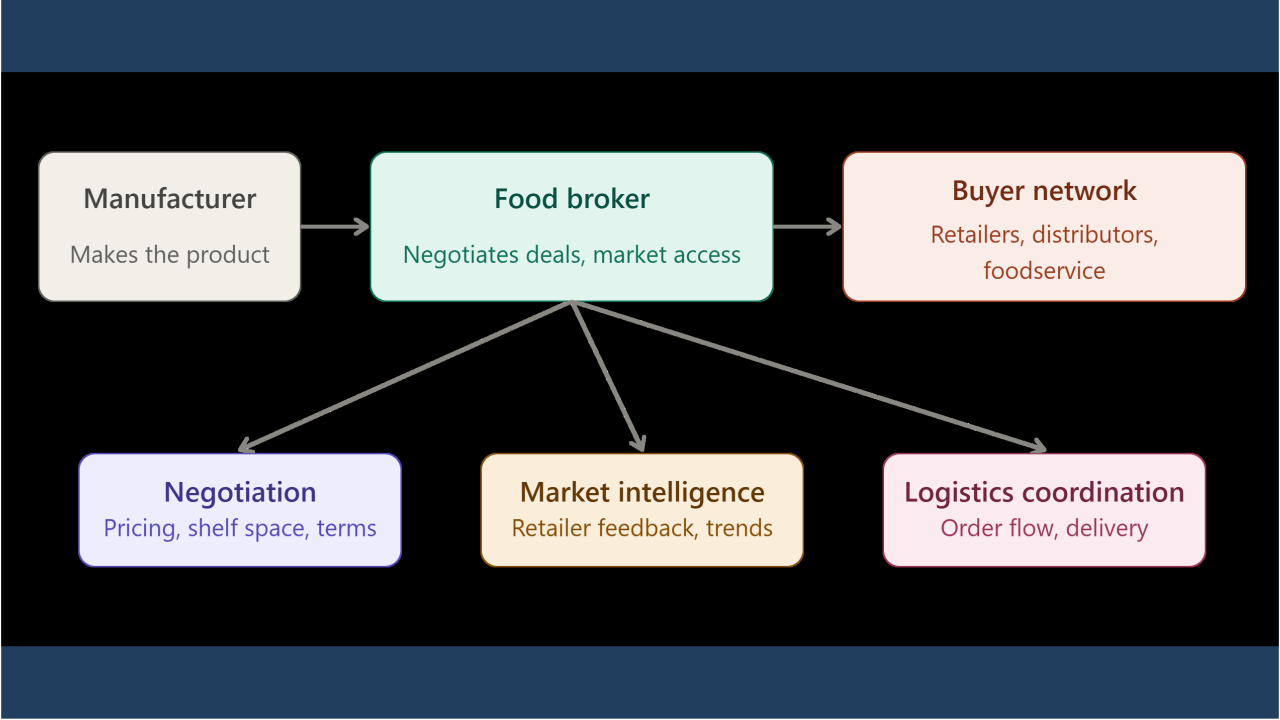
alt="Food broker diagram showing coloured bubbles and lines to each box on black background."

Manufacturing

Food Brokers: What they do for Your Brand

Most brands never make it past their local market. Not because the product isn't great, but because getting it in front of the right buyers is brutally hard. That's exactly where food brokers change everything. They carry the relationships, the access, and the industry intelligence that most manufacturers spend years trying to build on their own. Food brokers are far more than middlemen. They are strategic partners who open distribution channels, negotiate deals, and translate real market data into growth. Whether you're launching a new product or scaling an established brand, understanding how food brokers work is one of the smartest moves you can make.

May 21, 2026 · 5 min read

Get The Surch Report: new suppliers, practical insights and the food industry trends worth following.

Subscribe to The Surch Report

No spam. Just valuable insights. Unsubscribe anytime.