THE SURCH FOODS BLOG

Expert insights, sourcing guides and ideas that connect better food with better business.

Ideas and know-how for every part of the food supply chain.

9 de 156 articles affichés

alt="Hand lifting tomato sauce jar from grocery shelf with white label with green leaf on label."

Trends

How Consumer Trust Is Fueling the Rise of Private Label

Private label used to carry a certain reputation. Cheaper, maybe. Convenient, sure. But rarely the first choice if a national brand sat beside it on the shelf. That picture has changed, and in Canada it has changed fast. Consumers are buying more store brands and house brands because they trust them more than they used to. Price still matters. It matters a lot. But price alone does not explain what is happening. If shoppers felt private label meant lower quality, they would treat it like a backup plan. Instead, many now buy it on purpose. For buyers, procurement teams, manufacturers and suppliers, this change matters. Trust is no longer a soft marketing idea. It is shaping retail sourcing, product development, packaging decisions, supplier selection, and long-term growth.

29 mai 2026 · 10 min de lecture

alt="Smiling robot in restaurant with blue eyes and computer screen on chest."

Foodservice

Automation Is Changing Foodservice - But People Still Matter

What if the biggest threat to hospitality isn't labour shortages or rising costs - but the belief that technology alone can fix them? Across the foodservice industry, operators are discovering that the restaurants guests actually return to aren't the most automated ones. They're the ones that figured out where the machines end and the people begin. Balancing automation and human touch in 2026 foodservice isn't a philosophical debate anymore. It's an operational imperative. With 97% of operators actively improving guest experience and the online food delivery market projected to hit $2.02 trillion by 2030, the pressure to modernise is real. But so is the 52% of consumers still craving something no algorithm can replicate. The winning formula? Build smarter systems, then let your people shine.

29 mai 2026 · 5 min de lecture

alt="Molecular structures floating with grey background."

Ingredients

Functional Foods: What They Are, Why They Matter and What the Science Says

What if your food could do more than keep you full? For thousands of years, cultures around the world have treated food as medicine. Today, science is catching up, and the results are compelling. Functional foods are changing how we think about nutrition. They go beyond basic fuel, delivering bioactive compounds that actively protect the body, reduce disease risk, and support long-term wellness. From oats that lower cholesterol to probiotics that strengthen gut health, the evidence is clear: what we eat is one of the most powerful health tools we have.

27 mai 2026 · 5 min de lecture

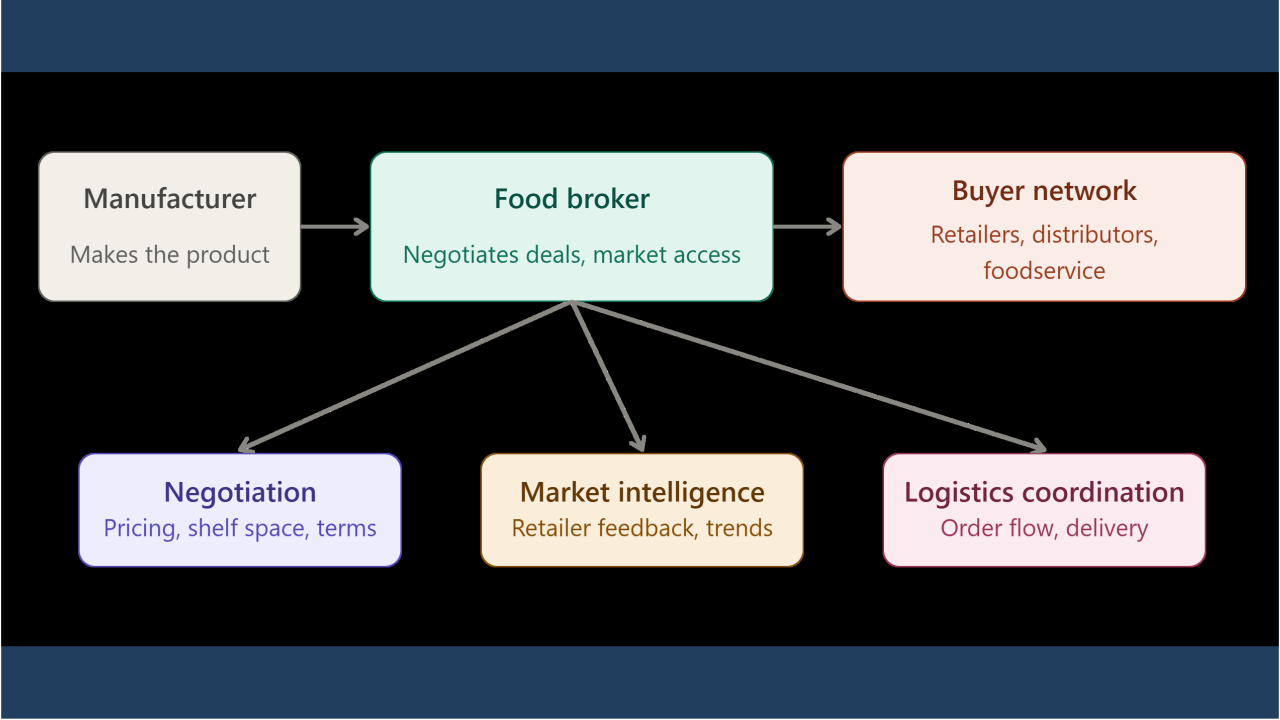
alt="Food broker diagram showing coloured bubbles and lines to each box on black background."

Manufacturing

Food Brokers: What they do for Your Brand

Most brands never make it past their local market. Not because the product isn't great, but because getting it in front of the right buyers is brutally hard. That's exactly where food brokers change everything. They carry the relationships, the access, and the industry intelligence that most manufacturers spend years trying to build on their own. Food brokers are far more than middlemen. They are strategic partners who open distribution channels, negotiate deals, and translate real market data into growth. Whether you're launching a new product or scaling an established brand, understanding how food brokers work is one of the smartest moves you can make.

21 mai 2026 · 5 min de lecture

alt="Two females in lab coats with blue hair nets in production facility with stainless steel tanks behind."

Co-Manufacturing

Custom Co-Manufacturing: Getting Brands Ready to Scale

Most food brands never build a single production line. They don't need to. The most successful products on shelves at Whole Foods, Costco, and Kroger were often made by someone else entirely. That's not a shortcut. That's strategy. Custom food manufacturing has quietly become one of the most powerful growth levers available to food brands today. With a global market projected to hit $274.7 billion by 2030, the momentum is undeniable. Brands that understand this model aren't just keeping up with the industry. They're leading it.

20 mai 2026 · 5 min de lecture

alt="Healthy bowl of vegetables over rice with chickpeas and quinoa in white bowl."

Ingredients

What’s Really Driving Healthy Food and Drink Trends in 2026

Healthy food used to feel like a category. Now it feels more like a baseline expectation. That shift matters. A lot. For buyers, manufacturers, product developers, and suppliers, the question is no longer whether health matters. It does. The harder question is what kind of health message actually works in market, especially when shoppers are balancing wellness goals against price, convenience, and plain old cravings. The short answer is this: people want proof, not promises. They want products that taste good, fit into real life, and do something specific. They also want labels they can read, sourcing they can trust, and sustainability claims that sound believable instead of polished. That is why the healthy food and drink market keeps growing even with cost pressures. Global healthy foods are projected to approach $900 billion by 2026, and functional food and beverage is expected to pass $793 billion by 2032. Those numbers are big, but the more useful takeaway is simpler. Health is mainstream, and mainstream categories behave differently than niche ones. They get tougher. Expectations rise. Shoppers compare more. Weak claims get ignored. If you work in retail sourcing, foodservice, food manufacturing, ingredients, packaging, or procurement, this is the part worth paying attention to.

30 avr. 2026 · 11 min de lecture

Alt="Top of metal cans with pull tabs. One full can and part images of surrounding cans."

Packaging

Common Packaging Failures and How to Avoid Them

Every year, millions of dollars in food products are lost. Not because of poor recipes or bad ingredients, but because of the box, film, or wrapper they came in. Packaging failures are among the most underestimated risks in the food industry, quietly compromising safety, shelf life, and brand reputation before a single consumer complaint surfaces. From chemical migration and moisture ingress to microplastic contamination and label non-compliance, the range of common packaging failures is broader than most manufacturers anticipate. Understanding what causes these failures and how to prevent them is the difference between a product that reaches shelves safely and one that triggers a costly recall.

24 mars 2026 · 5 min de lecture

alt="Recylcable packaging on blue, recyclable packaging on green, sustainable packaging on yellow background."

Packaging

Sustainability vs Functionality in Folding Carton Design

A single material switch, from a standard coating to a certified FDA-compliant alternative - doubled one product's shelf life from 90 to 180 days. That outcome challenges a common assumption: that choosing sustainability means accepting compromise. In folding carton design, the two goals are increasingly inseparable. The packaging industry is moving past the idea that environmental responsibility and functional performance pull in opposite directions. From AI-driven manufacturing precision to Scope 3 insetting strategies, the trends redefining folding cartons in 2025 show that sustainability vs. functionality is less a conflict to manage and more a design problem to solve.

23 mars 2026 · 5 min de lecture

Get The Surch Report: new suppliers, practical insights and the food industry trends worth following.

Subscribe to The Surch Report

No spam. Just valuable insights. Unsubscribe anytime.